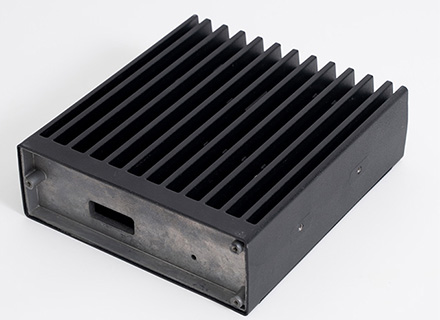
Is comhpháirt theirmeach innealtóireachta é doirteal teasa atá deartha chun teas a aistriú ó chodanna leictreonacha nó meicniúla chuig an aer máguaird nó chuig an timpeallacht leachtach, rud a chinntíonn go n-oibríonn gléasanna faoi bhun a dteorainneacha teochta uasta. Úsáidtear go coitianta i leictreonaic chumhachta, soilsiú LED, trealamh cumarsáide, agus córais uathoibrithe tionsclaíocha, agus tá ról ríthábhachtach ag doirteal teasa chun cobhsaíocht feidhmíochta a choinneáil, róthéamh a chosc, agus saolré táirgí a shíneadh.
prionsabal teirmeach agus meicníocht oibre
Tá trí chéim seicheamhacha i gceist leis an bpróiseas diomailt teasa i ndoirteadh teasa:
heat conduction (conduction phase):
heat is conducted from the heat source—such as a cpu, mosfet, or led junction—to the heat sink’s base through direct contact or thermal interface materials (tims). the efficiency depends on the thermal conductivity (λ) of the heat sink material, expressed in w/m·k.
heat spreading (diffusion phase):
within the heat sink base, the heat spreads laterally before reaching the fins. the design of the base thickness and material homogeneity significantly impacts uniform heat distribution.
heat dissipation (convection phase):
finally, the heat is released to the air through convection. the fins enlarge the surface area to accelerate heat exchange. in some cases, forced convection is applied using fans to increase airflow and improve the overall heat transfer coefficient (h).
Is féidir éifeachtúlacht iomlán an aistrithe teasa a chur in iúl mar:
cá háit
q = ráta aistrithe teasa (w)
a = achar dromchla éifeachtach (m²)
tₛ = teocht an dromchla (°c)
tₐ = teocht chomhthimpeallach (°c)
ábhair a úsáidtear i ndoirteáin teasa
(1) doirteal teasa alúmanaim
Is é alúmanam (al) an t-ábhar teasa is mó a úsáidtear mar gheall ar a chothromaíocht idir seoltacht theirmeach (~200–235 w/m·k), meáchan éadrom, friotaíocht creimeadh, agus éascaíocht déantúsaíochta. I measc na gcóimhiotal coitianta tá:
6061 agus 6063: easbhrúiteacht agus meaisínitheacht den scoth; oiriúnach do phróifílí móra doirteal teasa.
1070 agus 1050: alúmanam ard-íonachta le seoltacht níos fearr le haghaidh leictreonaic bheachtais.
Is minic a bhíonn doirteal teasa alúmanaim easbhrúite, meaisínithe CNC, nó teilgthe bás, agus is féidir iad a anóidiú i ndoirteal teasa dubha chun astaíocht agus luach aeistéitiúil a mhéadú.
(2) doirteal teasa copair
Soláthraíonn copar seoltacht theirmeach den scoth (~385–400 w/m·k), beagnach dhá oiread níos mó ná alúmanam. Is fearr é le haghaidh gléasanna ardchumhachta, soilse tuile faoi stiúir, agus modúil fuaraithe LAP/GPU. Mar sin féin, méadaíonn a dlús ard (8.9 g/cm³) agus a dheacracht próiseála an costas agus an meáchan. Is minic a chuirtear copar le chéile le halúmanam i ndoirteoga teasa hibrideacha copair-alúmanaim, rud a bhaineann feidhmíocht agus airíonna éadroma amach.
(3) ábhair chomhchodacha agus solúbtha
Úsáideann teicneolaíochtaí atá ag teacht chun cinn bileoga graifíte, cúr alúmanaim, nó comhchodanna polaiméire solúbtha mar ábhair doirteal teasa solúbtha. Úsáidtear iad seo i bhfeistí tanaí, leictreonaic inchaite, agus painéil faoi stiúir inlúbtha. Cuireann siad seoltacht mheasartha ar fáil ach solúbthacht agus saoirse dearaidh eisceachtúil.
aicmithe agus gnéithe struchtúracha
(1) doirteal teasa easbhrúite
a tháirgtear trí alúmanam leáite a bhrú trí mhúnla beachtais, ag cruthú próifílí easbhrúite leanúnacha le geoiméadrachtaí eite sainithe. Áirítear leis na buntáistí:
úsáid ard ábhair
cost-éifeachtach le haghaidh rith táirgeachta meánmhéide agus mór
fad inoiriúnaithe (“doirteal teasa gearrtha de réir faid”)
spásáil agus tiús na n-eite inchoigeartaithe le haghaidh patrúin sreafa aeir shonracha
coitianta i soilsiú faoi stiúir, aimplitheoirí agus rialtóirí tionsclaíocha.
(2) doirteal teasa eite sceite
Déantar iad a mhonarú trí sceitheadh (bearradh tanaí) ó bhloc miotail soladach, rud a chruthaíonn eití thar a bheith tanaí (0.25–0.5 mm) gan aon chomhéadan nasctha. Cinntíonn sé seo seoltacht teasa den scoth ón mbonn go dtí an eite. Úsáidtear go coitianta iad i modúil igbt ardchumhachta, LAPanna freastalaí, agus modúil chumhachta inbhéartóra.
(3) doirteal teasa eití nasctha agus eití fillte
comhdhéanta d'eití alúmanaim nó copair aonair atá nasctha le bonn le sádrán nó eapocsa teirmeach. Ceadaíonn na dearaí seo eagair eití an-dlúth, atá oiriúnach do chórais fuaraithe aeir éigeantaigh nó leachta.
Doirteal teasa eite nasctha: den scoth do chórais chumhachta tromshaothair.
Doirteal teasa eite fillte: bain úsáid as bileoga rocacha chun dearaí éadroma, dlútha a chruthú le haghaidh leictreonaic iniompartha.
(4) eite zipper agus doirteal teasa stampáilte
Déantar eití zipper a chóimeáil ó bhileoga eití idirnasctha, rud a thairgeann friotaíocht theirmeach íseal agus cóimheas ard neart-le-meáchain. Déantar doirteal teasa stampáilte a tháirgeadh go mais ó bhileoga miotail tanaí, atá oiriúnach do leictreonaic tomhaltóra ina bhfuil costas agus méid tábhachtach.
(5) doirteal teasa meaisínithe CNC
a úsáidtear le haghaidh riachtanais bheachtais amhail aeraspás, ionstraimí optúla, nó tithíocht leathsheoltóra. cinntíonn meaisínithe cnc lamháltas daingean (<±0.02 mm) and supports complex shapes like cylindrical or circular heat sinks.
design parameters and performance optimization
a high-efficiency heat sink must consider both thermal and mechanical design parameters:
| design parameter | technical consideration | effect on performance |
|---|
| fin height & thickness | taller fins increase area but raise pressure drop | balance between surface area and airflow |
| fin spacing | too narrow → restricted airflow; too wide → less area | optimized for airflow regime |
| base thickness | thick base improves spreading but adds weight | typically 2–6 mm for aluminum |
| surface treatment | anodizing improves emissivity from 0.05 to 0.85 | enhances radiation cooling |
| mounting method | screws, clips, or adhesives affect contact resistance | must ensure even pressure |
| thermal interface material | silicone pad, grease, or graphite film | reduces interface thermal resistance |
black anodized aluminum heat sinks are popular because black surfaces radiate heat more effectively due to their higher emissivity coefficient.
manufacturing processes
the manufacturing route depends on product size, precision, and thermal performance requirements:
aluminum extrusion: for standard heat sink profiles, cost-efficient and repeatable.
die casting: for complex shapes and enclosures, common in automotive electronics.
skiving & bonding: for high-performance and compact modules.
cnc machining: for customized or low-volume parts.
brazing and welding: to assemble hybrid materials such as copper-aluminum structures.
all heat sinks undergo surface treatment, deburring, oxidation resistance testing, and dimensional inspection to ensure thermal and mechanical consistency.
application fields
led lighting: circular or bar-type aluminum heat sinks dissipate heat from led chips, preventing lumen degradation.
power electronics: high-power converters, rectifiers, and motor drivers use large bonded fin heat sinks.
computing & servers: cpu/gpu modules use skived or zipper fin copper heat sinks.
renewable energy: solar inverters and battery packs require extruded aluminum cooling panels.
telecommunication: compact stamped aluminum heat sinks ensure efficient cooling in limited enclosures.
future trends
next-generation heat sink development focuses on:
graphene-enhanced aluminum composites with 40% higher conductivity.
3d-printed lattice heat sinks offering optimized airflow channels.
phase-change integrated heat sinks for high-density chips.
flexible polymer-metal hybrid heat sinks for wearable and foldable electronics.
these advancements aim to balance thermal performance, weight reduction, and manufacturing flexibility for evolving high-power and compact electronic systems.
from traditional extruded aluminum heat sinks to advanced composite fin structures, heat sink technology continues to evolve to meet the thermal demands of modern devices. understanding the thermal conduction mechanism, material characteristics, and structural design principles is essential for engineers to select or design the optimal cooling solution. whether for an led module or an industrial inverter, a properly designed heat sink ensures not only thermal safety but also the reliability and longevity of the entire system.